Wednesday, December 19, 2007

Nut marbles


This post is off to Bee and Jai's Click event on Nuts. Hummm was that difficult to guess? Its in the name itself . I really din't know what to make though there are several recipes with nuts. So here is something I created instantly and especially for this event. I made it just by picking up nuts with my fingers from different jars. It can't get simpler than this. I made marbles because I had the theme of the smart crow in my head. So took a jar and filled it with layers of Pistachio, Cashew, Almonds and Walnuts. It looked good. After the marbles were ready put them in a glass and imagined that the rest of it was filled with water. Blr has a gloomy weather right now and a picture indoors meant using the flash. So I grabbed the ChaTai/ Mat threw it open in the sit out and set up my subject in the natural light. Thats what you see here.

Another reason for making the marbles is for smarter consumption of sweet. They can be shaped into big ladu for kids but for me marbles are perfect. I get to have the sweet and eat it too. Dad can have a handful as he is sincere with his workout.
To make the nut marbles follow the super simple steps:

Ingredient

About 2 tablespoon each of Pistachio, Cashew, Almonds and Walnuts.
2 teaspoons of sugar
1 teaspoon ghee

Grind together the nuts and sugar to a fine powder. Heat the ghee in a pot. Add the ground nuts and sugar powder and mix well on sim till the sugar melts. Cool a bit till you can handle it and shape into marbles. This proportion gave about 12 marbles. Incase you want to make ladus for the kids you can take equal amounts of nuts. Add sugar as per taste and ghee just enough to moisten the powder so that it lends well for shaping.


Tuesday, December 18, 2007

Rolled and sliced Kothimbir Vadi


Rolled and sliced Kothimbir Vadi (Type II) and Zatpat Rasmalai


This Kothimbir Vadi is much popular in Marathi homes that follow Mangala Barve's recipe. As always this method is Mangala Barve's but recipe is mine. I made it for this guy who visits us once a year to help us with our paper work. This year he retired from Govt. service of 30 long years so I wanted to make it special for him. Along with lunch it was Kothimbir Vadi and Manisha's Zatpat Rasmalai for him. Thanks again Manisha, this is the second time I made it.

Ingredients

1 bunch Cilantro cleaned, washed and chopped
1 to 1.5 cups Chickpea flour/ Besan
4-5 green chilies chopped fine
1 teaspoon red chili powder
1/2 teaspoon turmeric powder
1/4 teaspoon asafoetida

Without adding water mix the dough and shape into 4X2 inch rolls. Like we did for the Nachani Kobi Palak Kabab . Steam in a greased tray for 30 mins or until you see a glaze. Cool completely and then slice into thin roundels. Be careful while slicing as cilantro stems make it slightly tricky. Shallow fry in a non stick pan until golden and crisp. Serve with chutney or ketchup.

My favorite Kothimbir Vadi however is the other type I posted earlier. While the rest of my family and friends are loyal to this one.


Find Kothimbir Vadi Type I here

Monday, December 17, 2007

Oil free ChavaLichi Amti


I am great fan of pressure cooking especially when it come to pulses and beans. This is the first time I have made this oil free amti. What made me do that is the fact that I was using coconut for the gravy. Coconut has enough oil already. So I skipped the tadka altogether. The amti turned out so good that none of us missed the oil or the tadka.

We found some fresh ChavaLi beans in the pod. The long pods looked great with the beans plump and tight. The colors of the pod a purple green and the beans a range of mature pale beige to the baby greens. These beans must have been a delicacy some centuries ago for an inspired a poet calls a young curvaceous girl, ChavaLichi Sheng!

This amti goes well with chapati, jowar/ bajari/ ragi roti as well a rice. Yesterday we had the yard long beans stir fried with just chilies they were so young and aromatic that we enjoyed every morsel of our dinner. Yard long beans too are ChavaLi Sheng but they yield the red beans that are small, the size of green lentils. Today the beans I used are the ones that yield the black eyed peas that are beige in color also known by the same name. Keeping the spicing light I made this curry that was completely different even though their names are the same.

Ingredients

1 cup mature ChavaLi removed fresh from the pods
1 potato quartered
2 tomatoes quartered
a small piece jaggery (optional)
2 cups water
salt to taste

For masala :

1 big onion
1/8 piece of a coconut or 2-3 tablespoon of grated coconut
1 green chili
2 teaspoon MTR sambhar masala
1 handful cilantro
1/4 teaspoon turmeric powder

To begin grind all the item to a course paste. In a pressure cooker mix together all the ingredients along with the masala and close the lid. Allow 1 whistle on high heat and another 1 on sim. Put off the heat and cool till pressure subsides. Give it a stir with a light hand such that it is mixed well yet allows the potato to hold itself. Serve with a squeeze of lime.

Friday, December 14, 2007

Methiche Ladu


and Hail Winter!

This is a winter speciality. It is not just anybody's sweet. "Oh really! Can we call it a sweet?" says my little nephew, jowling away.

You decide it. It has a good amount of jaggery in it attempting to make it a sweet. The flavors are robust and yet requires an evolved palate to appreciate it truly.

My aunt came armed with a supply of these methiche ladu for the entire family. This recipe is absolutely KOLI. She prescribes them for all in the winter, to strengthen the back and keep you warm and post natal must for women.

One time my uncle MJ carried them to Hong Kong and he was asked to demonstrate how they are consumed. They might have thought it was a Horse's creation LOL!

However as always my aunts and mother succeeded in getting us kids to get acclimatized to the taste. I still remember how I would hold it in my hand for a long time just about nibbling till the end. I loved the taste of halim in it though. Halim is a seed that swells like the tulsi seed/ sabja when mixed with saliva. I found that amazing at that young age.

It is more than a year now that I started blogging. I see my family searching for this recipe on the blog. They tell me a Koli blog is incomplete without this Methiche ladu recipe. Try them out at your own risk. Sometimes I recommend risking too ;).

Ingredients


1 kg Fenugreek seeds/ methi
¼ kg Gardencress pepperweed / Halim (Marathi)
¼ kg edible gum / Dinka
1 ¼ kg jaggery
4 nos coconuts
½ kg ghee

Methi to be dry roasted to dark brown color. Grind methi, halim and dinka in mixie. Melt ghee add jaggery, shredded coconut. Keep stirring till you get a sticky consistency. Add the ground powder. Mix well. Cool till you can handle the heat of the mix. Shape the ladu. This makes about 80 ladus. It has a shelf life of one month in the winter months.

This recipe can be made is a trial batch with 1 cup methi, 1/4 cup halim, 1/4 cup dinka, 1.25 cup jaggery, 1 coconut, 1/2 cup ghee.

Stay warm and stay indoors!

Thursday, December 13, 2007

Neer Dosa and Appam in Mangalore


At the eatery a display of typical Mangalore fare of buns, usli, uttapam, Kerala paratha, pole, pohe etc. I was feeling shy to go close for a picture so took one from my table.
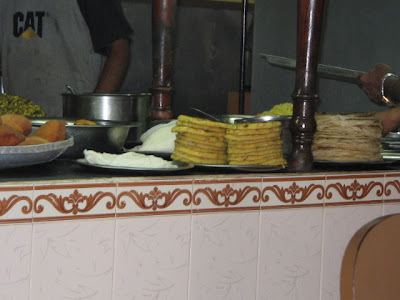


and a Temple Tour @ Rs. 1.36/ km

Just before Diwali at work they declared a compensatory holiday for the entire organization. I had already planned my other vacation with family and friends and here I was with 4 holidays at hand. I decide to go on a short tour, my criteria, it had to be cheap and only for 4-5 day . I checked with KSTDC and decided to take their South Canara Temple Tour.

Well once I had done a 5 day tour of north Karnataka with them about 2 years ago. The places covered were amazing but the stay at Bijapur had left a bad impression. So this time I just prepared myself for bad hotels and a smelly coach and made the reservations saying to myself this is an unplanned tour so I need not expect much.

This tour starts on every thrusday from Badami house, Blr. at 9.00 pm. As usual we reached early. My first surprise was the new coaches. They had better build more space and more leg room. Also since it had not rained the coaches smelt fresh. It helps to expect less I said to myself especially for the price we pay. Infact during my last trip with them I had suggested that they should offer luxury tours as their standard tour was really low budget.

Day 1:

The tour manager told us that we were going to cover 1400 kms to and fro. Man ! It meant a tour at Rs. 1.36/ km. That is absolutely a steal deal. Yet I kept reminding myself that I should not crib about the hotels they provide. He aslo announced that if all agreed he could show us a few more temples in addition to the itenery if we paid Rs. 50 more. It was obvious that it went into the private kitty. After munching on chutney sandwiches that we were carrying with us we went off to sleep that night. The bus passed through dense forrests, plantations and ghats.


Day 2:

In the early morning we reached Hornadu. We were provided a small room that we had to share with 2 other people. This facility was just to have a bath. It was a village guest house but was clean. After a hot water bath we walked down to the Annapoorneshwari temple through dense fog. It was an out of the world experience. This temple is surrounded by bettlenut and coconut plantations as you see in the backdrop of the temple gate below. This is one of the cleanest Hindu temple that I have seen. The darshan was calming, we saw the Godness being bathed as part of the Shodashopchar (ritual offering of sixteen items). It is a beautiful human sized idol made in granite. This region being home to Annapoorneshwari is truely blessed. I learnt in this trip what it truely means to do Annadan.

Annadan is supposed to be the highest level of charity that one can do in Hinduism. It is said that it is the only charity that truely satisfies the needy. If a man is in need of food he will take only as much as the capacity of his stomach and will say enough when he cannot eat more thus feeling trupti or satisfaction wheres all other needs are insatiable.

Annapoorneshwari is the goddess who can provide endless amounts of food to the needy. In this temple we see in her hand the spoons and utensils that are her tools. We took breakfast at the prasad hall. It consisted of Avalakki, patal pohe seasoned with red chili and mustard in oil with sugar and salt and sprinkled with water.

From here we went to Kalasa and then we proceeded to Shringeri. This place is of high importance as Adi Shanakaracharya established the first peetham here. He was looking for a suitable location for starting a peetham and at this place on the bank of the river Tunga he saw a snake sheltering a frog from the hot sun under its hood as the pregant frog was in labour. Adi
Shanakaracharya was taken aback by this scene of a serpent the natural enemy of a frog actually protecting it and immediately identified this place as a special one. People now feed the fish here on the ghats of the Tunga.


We washed our feet in the river and became Suchirbhut (the act of cleansing) and went on to take darshan of Sharda mata and Vidyashankara. Both the temples are beautiful and distinct. The Sharda temple interior is beautiful where as the Vidyashankar temple is decorated on the outside. It has carving of different Raashis in the corners. In the Shringeri Mutt there is a hall that displays paintings on the life of Adi. As a child I had a very spiritual impression of Shringeri Mutt in my mind based on the books I had read but it was quite different experience to be there. May be it being Diwali there were more visitors or something else I am not able to figure out. Pandit Gowrishankar is one person we know who has studied Vedic Culture at Shringeri Mutt and he used to visit us sometimes and explain to us all the nitty grities of Puja rituals. We had lunch here at the Prasad hall. It was impressive how well it was maintained. Food consisted of rasam, sambhar, majge/ buttermilk and heaps of rice.

In the evening we reached Kollur. After checking into a Guest house we got fresh and walked to the temple. It was the time for Mahamangal aarti and there was a huge rush. This temple seemed to be dominated by Malayali culture. It is the abode of the goddess Mokambika. We stood in the line for darshan for more than an hour and just at about the time of the aarti hell broke loose. We were squeezed into the mandap and I was gasping for air. I saw the priest coming with the aarti through the crowd pressing against each other. I told Dad to follow him when he would return to the Garbh gruha. Reached in front of the Goddess barely bowed my head and sprinted out into the open space. This temple is not kept clean and reminded me of all the temples in Maharashtra where similar experiences are inflicted on the devotees. We took prasad at the dinning hall and returned to the guest house to retire for the day.

Day 3:

Began in Murudeshwar. The famous 65 ft Shiva statue dominates the skies of the coastal town. Though we were on the beach we were warned not to play in the sea as we were to travel all day and did not want the coach to be smelly. So we just watched others have fun in the sea. There is a restaraunt that caught my fancy as it was built on stilts in the sea.

Our next destination was Anegudda Vinayaka temple. This temple architechture is similar to Konkan region in Maharashtra and Goa. It is said, when Bheema was trying to kill an asura in the form of an angry elephant with his gada, he lost the battle. Thats when this Ganapti gave him a sword with which he destroyed the asura. Hence this temlple is dedicated to Vinayaka.

Nearby there was an interesting place called the temple of Halu MakaLutai. The story associated with this temple goes like this. Kumba-mukhi, the sister of Ravan and Shurpanaka prayed to this Goddnes to grant her children. However when the Goddess appeared before her she was dazzled and instead of asking for children. She asked for the Goddess be granted with children and The Goddess said Tathaastu! Hence every five years a linga pops up from the ground. It is a strange geological phenomena observed here. In the courtyard of the temple you see these rocks that look like lingas emerging from the ground. Quite miraculous you will agree. This Goddess is offered bettlenut flowers in worship.

From here we went straight to Udupi. It was my dream to go to Udupi after reading the story of Kanakadas for whom Krishna turned around and gave darshan to his devotee. This is the only temple where the diety's back is to the main door. Then on the Darshan is taken at the rear. Sadly even centuries later, after Kanakadas not much has changed here. The Lord is still locked up in the sanct sanctorium and decorated with flashy daimonds and the keys to the temple still lie with the Madhavas. It was also my dream to have prasad at the bhojanshala which is so synonimos with Udupi. Thousands of people are fed here. Though I am used to temple dinning halls and culture associated with it. Udupi is something one has to experience atleast once in a life. We even saw some people eating on the floor, no not even a banana leaf was used. They were observing some austerity in lieu of some favor they might have asked from Krishna. It was a shocking experience for me and definitely opened up my mind a bit more.

We were now off to Kateel to see Durga Parmeshwari. The temple exterior is in Konkani style while the sanct sanctorium is in Kerala style. This temple is built on an island in the river Nandini, connected to the mainland with a bridge.

From Kateel we went to Mangalore and went straight to hit the beach. The highpoint of the trip was to check into Lalit International at Suratkhal. It is a 3 star hotel thats going through a rough patch so KSTDC gets the best deal. We have paid Rs.1400 for a similar room at other times and this entire package had cost us a mere Rs1900/ person. The restaraunt has been closed down due to lack of customers. So we walked down to Sadanand about 10 mins from our hotel. Yes they are the same guys from Fort, Mumbai and they spoke to us in Marathi as they overheard our conversation. I made it a point to have Gudbad, the Mangalorean sundae and did not find it exceptional.

Day 4:

We began the day by visiting the Gokarnatheshwar temple, it new and built by a liqour baron very glitzy and not my type of a place however the cleanliness was striking.


The next one was the Manjunath temple at Kadri with its beautiful Brahma idol dating back to 968 A.D.


We started our return journey to Blr. On the way we were to go to Dharmasthal and Kuke Subramania. I had heard so much about the rush and my brother's warning echoed in my ears "It is the Pandharpur of the south". Yes it is in terms of the rush yet clean, non-corrupt and organized. Our last stop was at Kuke Subramania where one can perform rituals like sarpadosh etc.

Day 5:

At 6.30 am we were back in Blr at Badami house. I was done with my dose of temple tours. No more temples for me I resolved, however only until I went to this Paradise and there was a temple to be visited there too.

Tuesday, December 11, 2007

Chole Naan and The Mela


Ole ~~~ Ole ~~~ Chole ~~~ Chole~~~

We would sing as kids but that time Chole bhature was our favorite now it is Chole Naan. I am yet to find a self respecting Indian who does not like Chole.

Many claim the Chole they make is the best. Just try my version of fingerlicking Chole and let me know.

I invite anyone and every one with their chole with anything viz, pulao, roti, puri, Bhakri etc to link up here. I read Anita was served idli with chole.

Come one come all, Punjabi, Marathi, Madrasi, Bongali~~ Anne Gujjuben tame kyan che~~~ welcome to the Chole Mela !!

Leave a link in the comments till 9th Dec 07. Later I'll compile the list and update the post.


And here is my recipe:

Ingredients
1 cup Kabuli Chana / Chickpeas soaked overnight
1/2 cup chana dal/ split chickpeas soaked for 2 hour
2 large onions
2 large tomatoes
6-7 pods of garlic
1/2 inch piece of ginger
1 tablespoon coriander seeds
1 teaspoon cumin seeds
1 teaspoon Koli Masala or Garam masala
1 teaspoon red chili powder
1/2 teaspoon turmeric powder
2 big handfuls chopped cilantro
1 tablespoon + 2 teaspoon oil (I'm generous :)
1/2 teaspoon mustard
1/4 teaspoon asafoetida

Pressure cook Kabuli chana and chana dal together. Meanwhile in a saucepan fry the rough chopped onions till pink in 1Tb. sp. oil. Add tomatoes cook till soft. Add garlic, coriander seeds, cumin seeds, Koli Masala or Garam masala, red chili powder, turmeric powder, chopped cilantro and fry for 2 mins. Let the it cool a bit and then grind the masala t smooth.

In the same pan add 2 teaspoon oil and make tadka of asafoetida and mustard. Then mix in the masala and the boiled Kabuli chana and chana dal. Bring it to a rolling boil. Serve hot or cold it tastes divine actually stale is better after the microflora has blossomed ;).
__________________________________________
Updated: 11th Dec 07
Wow 9 recipes for chole! Thank you ladies :) !
  • Asha travels 16yrs back in time and chole make her home sick.
  • Arundhati shares the secret of a deep brown chole.
  • Easycrafts makes a saatvic chole that look nice and creamy and the secret in chickpea flour.
  • Aparna's chole with cabbage reminds me of cabbage stir fry with chana dal that is loved in most Koli homes.
  • K's Chole for a pressure cooked no masala frying business cooked for 35 mins yet leaving you free no sweat type recipe.
  • Punjabi Chhole! by Anita and some therapeutic masala frying.
  • Read about Meera's experiments with chole and the American Desi accompaniments will make you smile.
Hummm now chole every alternate week. Dad shouldn't crib because it is different ;) Lol.

Monday, December 10, 2007

Back from Paradise

Hey Friends


Just saying hi!


I'm just back from paradise and a long vacation with family and friends. Hope you all have been well? Thanks for visiting here and leaving comments while I was gone. I will update the Chole Mela post soon.

Meanwhile here is a picture....ummm you got to comeback for the special post to read where I had been or figure out.

Wednesday, November 21, 2007

Tuesday, November 20, 2007

Date N Chocolate Cake


I was trying the chef guideline to get a flat cake top by lifting the cake batter on to the sides. But I didn't do it right so you see the depression in the middle even though the cake had risen well.


This Date N Chocolate Cake is really simple to make and is full of nutritious elements. It is also a very soft cake by eggless standards.


Ingredients

1 cup all purpose flour
1/2 cup drinking chocolate
1/4 cup cocoa powder
2 cups thick buttermilk
1 cup sugar
1 cup fine chopped dates
1/4 cup walnuts and pista
1/4 cup ghee/ butter
1/4 teaspoon raspberry essence
2 teaspoons baking powder

I made this cake almost six months ago for a party and was in the draft for a long time. First sieve all the dry item together, all purpose flour, drinking chocolate, cocoa powder and baking powder. Dust the date and nuts in the flour and keep aside.

Beat the ghee till fluffy. Add sugar and buttermilk and beat again till light. Now fold in the sieved flour mix along with essence. Once homogenously mixed add the dates and nuts. Pour the batter in a greased and floured tin. Bake at 180 deg Cel for 25 mins or till the knife comes out clean when pricked.

Cool in the tin for 10 mins then turn it on to a rack.

I had served with Fig Sauce.

Monday, November 19, 2007

Doodhi ~~ Halwa

You see here Doodhi Halwa or Bottle gourd pudding with charoli nuts and a tiny piece of preserved pineapple for decoration


Many moons ago in Mumbai landed a Marwadi. Like all Marwadis he too thought it was the ideal place to earn money real quickly. This story is of the times when Doodhi halwa was considered a sweet associated with fairs and one could buy things for 2 paise. The Man saw a fair going on in Bandra during the Mount Mary festival. He thought of selling Doodhi Halwa at the cheapest that any one can buy. Now Doodhi Halwa is not a cheap sweet. It needs Ghee, Khava, Dudhi, fuel and manpower. Nevertheless he put up a huge hoarding announcing Doodhi Halwa @ 2 paise. Most Mumbaikar look for cheap deals and this was not something they were going to miss.


There was a huge que in front of this shop. As you know Mumbaikar love to line up every where be it Siddhi Vinayak for Darshan or Samant's at Dadar to buy Chakka on a Dasara day, so there they were. Many wondered why this shop was unlike the usual mithaiwala's. This one was a tent closed from all sides and ust one person at a time was allowed to enter. Another thing one noted was no one seemed to be coming out from the entrance. People enquired curiously. The Doorkeeper informed that people did not want to let anyone share the wonderful experience so prefered to leave from behind the tent. Some smarty pants went to the exit. They saw all the people coming out laughing. They thought wow one had to have the special Doodhi Halwa.


When each one entered they saw an empty tent with a huge Doodhi (bottle gourd) hung at the center of the tent with a string and a board written in Marathi, Doodhi Halwa for 2 paise. All people had a great laugh, Yes it was Doodhi Halwa @ 2 paise. Oscillate the Bottle gourd of course in Marathi means Doodhi Halwa! The typical Indians that we are we keep quite when we are fooled so they kept mum while the Marwadi collected the money and went home happy. Yet they had a good laugh at themselves for 2 paise.


This has been a favorite joke when we were small and always remembered when we enjoyed Doodhi Halwa.


So if you don't want to be fooled make your own Doodhi Halwa.

Ingredients

2 cup grated bottle gourd
1/4 cup sugar
1/4 cup khava/ condensed milk solids
2 tablespoons ghee/ unclarified butter
2 teaspoon charoli nuts or any other

I like my halwas rich always. So here is how we do it. Heat ghee and fry the khava till pink. To this add the sugar and stir till molten. Do not let sugar caramelize. At this point take the grated doodhi that would be watery and squeeze out the water as much as you can. Pack it tight in the measuring cup add this grated Doodhi to the khava sugar mix and keep stirring. When the Doodhi Halwa leaves the sides of the vessel and forms a mass in the center its a signal to put off the heat. This might take 20 mins max. Decorate with charoli nuts for the old world charm or any other nut of your choice.

Doodhi halwa can be enjoyed warm with Vanilla icecream or chilled just a bit on its own. My version is quite gooey if you like it that way.

Also try Jugabandi's microwave version and Suma's lighter version.

Friday, November 16, 2007

Amba Poli

Amba Poli of a different kind


There are forums to fight plagiarism, I scream, you scream and it just ends there. Lately however my sitemeter gives me a good insight into how plagiarism happens. Someone searches on this blog, many times not another blogger. Then the treasure hunter sends the recipe to a blogger requesting to post the recipe with some creativity from the pirate. I say to myself, "Good we are seeing new creations in the blog world" and mind you without a word of acknowledgement. Then my blogger friends will ask for proof to take action. I am sick and tired of the same game. I do not want to waste my precious energy on such things.


This is an appeal to all bloggers incase some one sends you a request to post their own recipe the least a blogger can do is just verify the originality before being party to plagiarism, I like to believe unknowing that is.


You know who you are! Are you running out of ideas?
_______________________________
Anyways sharing here a picture of Amba PoLi, Mango leather a friend sent me. This one is brittle unlike the soft succulent ones that we know of in Mumbai. This is from coastal Karnataka.

Wednesday, November 14, 2007

Thalipeeth Just Zakas !


We went on a 5 day tour last week covering South /West Karnataka. We enjoyed the typical Southern fare only to return home with a craving for Marathi food. What can be more Marathi than thalipeeth. We returned home in the morning hours so it had to be a filling one as we planned to catch up on sleep post breakfast as we had travelled all night in a bus and we had fatigue.

The good things about Thalipeeth are it is multigrain, high fibre and yummy a perfect power packed breakfast.

Ingredients

1/2 cup of five flours ( rice, wheat, chickpea, finger millet, pearl millet)
2 onions
2-3 green chilies (I used ripe red chilies)
2 handfuls chopped cilantro
1 teaspoon coriander powder
1 teaspoon cumin powder
1/2 teaspoon red chili powder
1/2 teaspoon red turmeric powder
1/4 teaspoon asafoetida
2 cups water


Mix all the ingredients and make a soft dough. Take a small wok/ kadhai and oil it generously. Preferably use a non-stick wok. Divide the dough into four parts and line it on the walls of the wok by patting the dough ball with the palm of your hand. Make holes in the thalipeeth to avoid puffing. A good thatlipith has to be crisp so it needs to remain flat. See below


Keep the wok on medium heat, cover and roast the thalipeeth till the inside dries out. Check the inside, if its golden it is done. Remove from the wok and serve hot with coconut chutney. Traditionally thalipth is served with a blob of homemade unclarified butter called LOni in Marathi or Benne in Kannada arrey yaar it's Makhan in Hindi.


One tip to remember thalipth can be served only one at a time. Do not make thalipeeth in batches. It looses taste once cooled. To enjoy it thoroughly it has to be eaten hot.


Also the thalipeeth has to be lined up in a cooled vessel else spreading the dough ball is difficult. Else you can use two woks so by the time one is cooled other one is cooking.

I bet you will comment Thalipeeth Just Zakas !

Happy Childrens day to all the kids as well as the adults for I know all adults wish they could be kids again!

All my kiddos, Pranav, Anushka, Anshika, Nirbhay and Sujal.

Have fun. (@)>--

A Marathi saying for this day:

LahaN_PaN Dega Deva Mungi Sakhare_cha Rava.

Which means: God give me the humility of an ant so that I can enjoy the sweetness in life.

Updated:
My friend Vinaya tells us thalipeeth is called sthaalpishtashtakam in Sanskrit. I guess sthaal means place-pishta means carbohydrates-shtakam means pancake. Vinaya is the broken sandhi correct? I haven't studied sanskrit but love to play with the words. If I am wrong thank me for a laugh, I know you will.
vinaya said...

hey! a very good try indeed. (A: Thats my friend ). The break was suchsthaala (thaali)+ pishta (peeth /carbs) + ashtakam ( eight verse poem)It was actually a eight verse poem which described how intricate and interesting the process of making a thalipeeth is.. grains are roasted at different heat levels ( some more, some less) how they are ground on a "jaate", and how a lovely thalipeeth is made, which tastes divine with loni. I guess the poet must have been a foodie himself, and just might have a food blog of his/her own in those days.

Tuesday, November 13, 2007

Cucumber Salad


Diwali celebrations are over and people are complaining of overeating all the sugar rich and fat laden food. This cucumber salad is a perfect antidote for the Diwali mania. We had this salad with boiled corn on the cob.

Ingredients

2 big cucumbers peeled and sliced

1/2 cup shredded cabbage

1 big handful fresh cilantro leaves

1 green chili

3-4 cloves garlic

1 tablespoon Mayo (I used eggless)

1/2 teaspoon sugar

salt to taste.

In a salad bowl put the sliced cucumbers and cabbage to chill for 20 mins this will lend the crunch. Meanwhile in a mortar and pestle coarse crush the cilantro, green chili and garlic. Remove the cucumber bowl add the coarse crushed herbs, sugar, salt and mayo. Mix well to get an even coating. Serve immediately.

This perfectly crunchy salad livened by the spice of green chili, cilantro and garlic accompanied with boiled corn on the cob is just what one would enjoy most post all the festivities.

Thursday, November 08, 2007

Faral


Tumha Sarvanna Divalichya Hardik Shubechya !!!


Marathi Divali Faral, Karanji stuffed with dry coconut and pedha mix, Tikhat Shev, Rava Ladu, Patal Pohe Chivda, Gor Papdi (my Guju influence).


A Very Happy Divali to All !!!


These Chiroti are coming your way MJ Kaka in celebration of your spirit to fight the odds and for beating them out. We all wish you and Aruna Kaki will be able to continue with your treks to the Himalaya just like the last 18 years once again.


Love to all my family and friends !!!

Wednesday, November 07, 2007

Dr. Roopa's Bhuni Arabi


Two weekends ago when Uncle Dheer visited us he took us to meet his old friends. In his usual style he told us this family is special, J.Nath paints South Indian life on his farm in Kodaikanal and his daughter and SIL have lived with the tribals for 10 years. Yet inspite of this introduction I reluctantly agreed to go visit the family that's when I realized over the years I am turning more into a recluse.

J. Nath, The painter and his painting

We were greeted at the door by a young girl, Gayathri. I was told she is the grand daughter of J Nath. As we stepped in the painter himself appeared from a room inside greeting Uncle Dheer in Punjabi. This is Dr. Roopa he said pointing to his daughter. Namastes exchanged and we settled down onto the sofas. We went in to a room where Jayaji, his wife was resting. To my surprise she talked to me in Marathi. After the initial awkwardness there was a change in mood. Roopa was cooking for all of us single handedly, so I went to ask if I could help. I saw she was roasting some besan. While the tomatoes bounced in the boiling water. She was making sabut moong dal with tomatoes, cauliflower and boiled Arabi lay on the side. Curious I asked what the powder was, she enlightened me, besan, dhania, jeera powder.


As I meddled in her way, I got to know that she taught at Rishi Valley School where her kids studied. I was quite curious to know what she taught by now knowing that she was a surgeon and her speciality, Community and Public Health. As we talked I found out that She was from Fort Convent, Mumbai a sister school to my school. I soon discovered I was with a highly evolved family. Deva was not at home that day, I missed a chance. Both Roopa and husband Dr. N. Devadasan served the tribals in the jungles of Gudalur for 10 years until couple of years ago when Roopa decided to focus on her children while Deva continued his research on the tribal health. Read all about these change makers here.


It is such a pleasure to listen to Roopa talk about everything around her and that affects the common man. Even J Nath felt proud of his daughter as he was listening to the discussions we were having, oscillating between health, medicine, alternative medicines, her time with the tribals, spiritualism, music, painting etc. Yes were with them for atleast 6 hours. Dad got up from the sofa twice in an attempt to leave, as he does not like to stay on at any place till the host feels discomfort. Each time J Nath would ask him to stay on longer. Post lunch he got the tea made and served us the famed Ginger biscuits from Kodi. While we enjoyed the hot tea, it was fun to hear a brief on the painter's life from him. He is childlike and a great storyteller. I was watching him as he talked animatedly about life before Mumbai happened and and now the reclusive life he leads along with Jayaji in Kodi.

We talked about many things and some of Roopa's words will ring in my ears for a long time.

On alternative medicine:

"I am trained in allopathy, but having lived with the adivasis and watched and heard alternative medical practitioners, in all these years. I see no conflict in medical rules. I have gone out of the framework and have realized, Who am I to come between the healing process and the sufferer? I would like to be known as a healer rather than a doctor."

On life of the adivasis:

"We the city bred consider ourselves to be civilized but we need to learn from the adivasis their evolved knowledge of survival. We only take from nature but I have never seen an adivasi collect a tuber for a meal without planting an eye back into to the soil."

On the tough choices she has made in life:

"I have been able to hold together."


As we take leave, I hear her telling Uncle Dheer about a new school, she and Deva are starting soon.

_________________________________________________

At lunch Roopa treated us to a Punjabi meal of Roti, Cauliflower, Bhuni Arabi and Sabut Moong Dal! Cauliflower stir fried in a bit of butter topped with generous amounts of ground pepper and salt. It was nice and crunchy and tasted yummy. The Sabut Moong dal was flavoured with blanched tomatoes and spiced with a dash of red chili powder and turmeric. Rotis served hot off the tava. My favorite was the Bhuni Arabi. Here is the recipe I mentally registered as I watched Roopa cook and after tasting it I had declared to her that it was going to be a post on my blog. You will agree with me that Dr. Roopa is a fabulous cook but a even more a highly evolved human being just like the rest of her family.


Ingredients


1/4 kg Arabi/ Colocasia tubers

2 tablespoon chickpea flour

1 teaspoon corriander powder

1 teaspoon cumin powder

1/2 teaspoon red chili powder

1-2 teaspoon dry mango/ amchoor powder

1 tablespoon oil

salt to taste


Boil and peel the arabi, keep aside to cool in a plate. Meanwhile in a wok dry roast the chickpea flour till it gives an aroma. Add corriander, cumin and red chili powders and roast for another 5 mins. Pour the roasted powder over the arabi. Shake the plate so that the arabi rolls in the flour and it gives an even coat. Now heat the oil and roast the spicy flour coated arabi till brown. I actually missed watching the last step as I was outside in the living room talking with her father. I forgot to ask her about it.

My dedication to this lady whom I have begun to admire and hope to stay in touch with is a healthier version of the same recipe.

Boil the arabi with tamarind and peel. Keep aside to cool in a plate. Meanwhile in a wok dry roast the chickpea flour till it gives an aroma. Add corriander, cumin and red chili powders and roast for another 5 mins. Skip the amchur powder as we have already used tamarind. Pour the roasted powder over the arabi. Shake the plate so that the arabi rolls in the flour and it gives an even coat. Now in a preheated oven broil the spicy flour coated arabi till brown.

This arabi preparation is among the best I have tasted. It can be served as a starter not only that it can be made in advance and hence an ideal recipe for a party.
Updated on 27th Dec 07
The taste of Arabi flavored with amchoor is the taste of rustic Punjab but tamarind converts it into a more southern experience. Use little tamarind so that it is not overwhelming.

Tuesday, November 06, 2007

Wild Greens, HonegoNe Stir Fry

Name the Wild Greens you see here.

They are runners with green globule like flowers. Probably these are babies. My Sopu/ leafy vegetablewala tells me it is called HonegoNe in Kannada. He knows he has met the right person to teach about new veggies. These are supposed to be good for the eyes. What are they called in English or any other Indian language?

He sold that entire lot in the basket for just Rs.7. These take a lot of time to clean and like all leafy vegetables that demand thorough sorting and cleaning can be cooked only on the weekends. This lot was so fresh that it had an instant pick me up effect on me. My Dad tells me we get them in Mumbai too when the adivasis of Thane and nearby areas visit the city. So they are very cheap but a rare treat.


These greens are new for me so they deserved full respect. So well it had to be a simple stir fry with just a dash of oil.

Here is what I did:

Ingredients

1 lot HonegoNe greens chopped fine
2 big Onions sliced thin
2 green chilies chopped
2 teaspoon oil
salt to taste

Heat a wok and on high add oil and fry the onions till translucent. Add the chopped green chilies and the chopped HonegoNe greens. Stir fry till dry. Add the salt at the end just before putting off the heat. This is important as greens before cooking are voluminous and after cooking shrink to give very little bhaaji and salt required is very little.

We enjoyed this HonegoNe sopu/bhaaji with the famous Belgaum bakri (not a goat but what Marathis call Bhakri) made by an enterprising women's group. So when I'm lazy I know what to do. These Jolad rotis are dry and thin like khakara and last almost a month. Just before eating they have to be warmed over a flame like a papad. The HonegoNe sopu is fragrant and can be enjoyed the best in this simple form.

A glass of spicy butter milk to wash down this dry combo is a must and you might be complimented with a burrrp!

Updated:
I learnt a little more on Lakshmi's Taste of Mysore.

Monday, November 05, 2007

Quick Fix Chinese Meal


I used to love the Knorr soups though I don't follow the exact measures on the packet. I make the soups thinner than the cover directs as that's how we like our soups. So when Knorr introduced their Chinese ready mixes I had to keep them handy for those times when I am pressed for time. Yes though both of us like to cook at times we like to take a shortcut as much. We tried the Hakka Noodles sauce mix and the Chinese chili. Following the direction is easy. I had to post this review for my brother who loves Chinese food. We made the Chinese chili using baby corn, onion and capsicum. While for the Hakka noodles I used just onions and capsicum. My touch to this ready to make meal was the use of mustard oil, that gave a spicy sharpness to these dishes. The noodles were my usual Ching's.

It is in no way gourmet food but meant to satisfy a gourmet's craving for good food instantly that is the success of this brand. I am also blessed that my Dad quite a gourmet of Indian food does not complain about International cuisines that I try from time to time or such quick fixes.

Here it goes to Click, an event for all good looking things conceptualized by Bee & Jai at Jugalbandi

Friday, November 02, 2007

Extra Terrestrial Specimen


Our friend Gauri Dutt has adopted the bong culture credit to her husband, Shom . Lately her sasural Kolkata has been in news due to the celestial body observed in the area. So when I opened that packet she sent me with her Dad, Uncle Dheer, I exclaimed, "Is this an extra terrestrial specimen. A closer look told me it was a special gift from my fave chikki shop , I had written about earlier, a Maganlal's creation. At Maganlal's they are not just visionary they push themselves to create new delites like these. If you haven' t guessed what it is by now, let me be explicit. It is a chikki, Dud! If you knew that one, tell me what variety is it ? Well it is the black sesame seed chikki. Ain't they innovative! To read all about the benifits of black sesame seeds click here.


When I was on a weight loss program back in 2002. My dietician had prescribed 2 teaspoons of black sesame seed for snacking for my 4 o'clock hunger. She guides Miss India's too so this is a much tried and tested prescription. It helps prevent hairloss during weight reduction, provides fiber and satiates hunger she said. Gosh it reminds me of days when I was the fittest with glowing skin and hair and P showered compliments on me. Can history be repeated?
:)
Update from Gauri: Sesame plants are flowering in the fields and will be ready for harvesting by Dec and then it is time for Sankrant and Tilgul, sesame ladu. This is an example of how the Indian traditions are ruled by the seasons, needs of the body for the season and the spirit of celebrating the harvest. The black ones are with husk and the pale ones are the dehusked ones.

On Trail